
Property taxes catch more Pittsburgh homebuyers off guard than almost anything else in the process — because they don’t work the way most people assume. Here’s what you actually need to understand before you fall in love with a house.
The short version
Your property tax bill depends on two things: your home’s assessed value and the millage rate of the municipality and school district it sits in. In Allegheny County, both of those can vary a lot more than people expect — sometimes even between two similar homes on the same street.
Why Allegheny County’s system is unusual
Allegheny County hasn’t done a full countywide property reassessment since 2013. Most assessments are still based on values from 2012. To keep that fair as home prices have changed, the county applies something called the Common Level Ratio, or CLR — a number that essentially adjusts old assessments to reflect today’s market.
In 2026, the CLR sits around 54.5%, which means your assessment generally shouldn’t exceed about 55% of your home’s actual current market value. Here’s why that matters: that ratio has dropped a lot — it was 81.1% back in 2022. A dropping CLR means a lot of homeowners are now over-assessed relative to what the formula says they should be. If you bought a home recently, or you’re planning to, it’s worth checking whether your assessment lines up with that ratio.
Why the same house costs different amounts in different towns
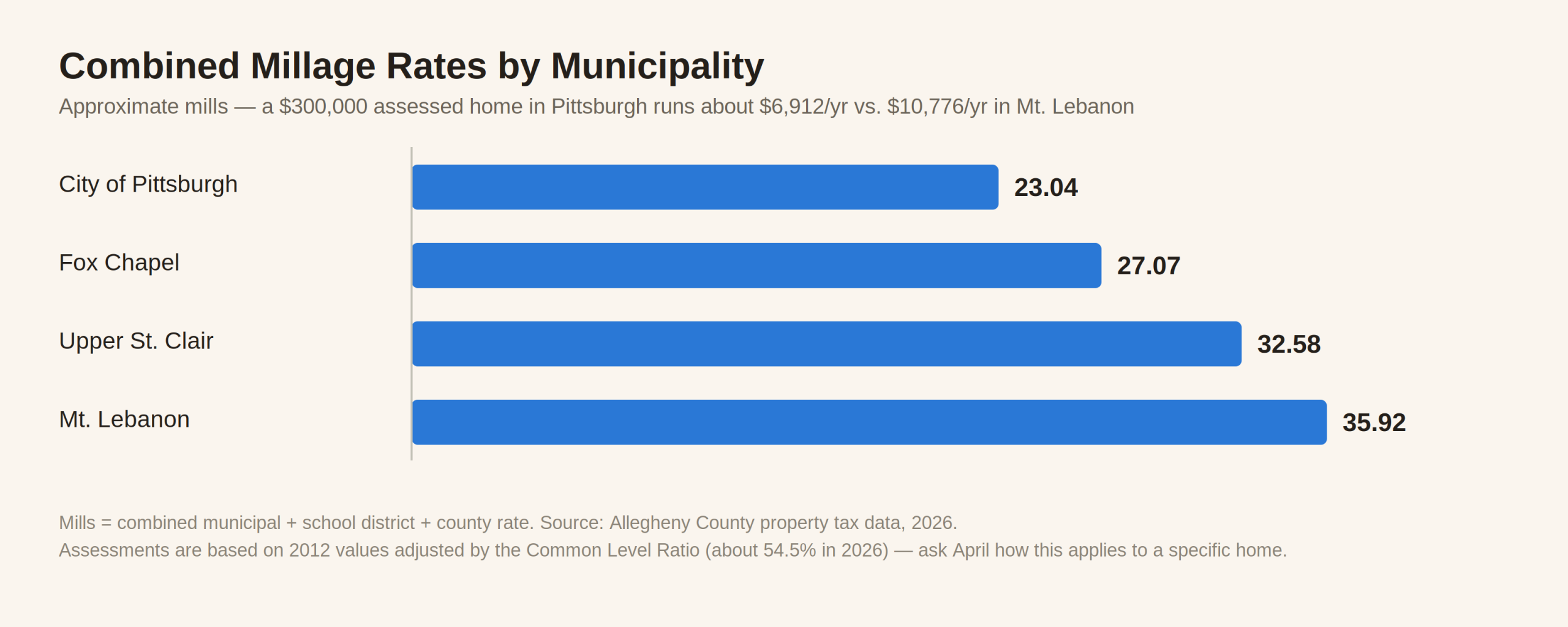
Millage rates vary significantly by municipality. A mill is one-tenth of one percent, and your combined rate (municipal plus school district plus county) gets multiplied against your assessed value to produce your bill. To give you a real sense of the range:
- City of Pittsburgh: about 23.04 mills
- Fox Chapel: about 27.07 mills
- Upper St. Clair: about 32.58 mills
- Mt. Lebanon: about 35.92 mills
Here’s what that looks like in dollars: a home assessed at $300,000 would generate roughly $6,912 a year in the City of Pittsburgh, versus about $10,776 in Mt. Lebanon. That’s a difference of nearly $3,900 a year — for the same assessed value. Neither number is right or wrong; they reflect different levels of municipal and school district spending. But it’s a number you should factor into your budget with your eyes open, not discover after closing.
Can you appeal your assessment?
Yes, and sometimes it’s worth it. If your assessed value is higher than your home’s market value multiplied by the current CLR, you may have a case. A few things to know:
- Filing an appeal is free. If you want a professional appraisal to support your case, expect to pay $300–$500.
- The standard appeal deadline is March 31 each year. If you get an interim assessment notice for another reason, you typically have 40 days to respond.
- Bring evidence: a recent appraisal is the strongest option, or three to five comparable sales from the past year.
- One caution — an appeal can occasionally result in your assessment going up instead of down, if the evidence shows your home is worth more than currently assessed. This happens most often in districts that actively review appeal filings for that possibility.
What this means when you’re house hunting
Don’t just compare list prices between two homes in different towns — compare what your actual monthly payment would look like once taxes are factored in. A slightly more expensive home in a lower-millage municipality can sometimes cost less per month than a cheaper home in a higher-millage one.
Frequently Asked Questions
Why are Allegheny County property assessments so inconsistent?
Because the county hasn’t done a full reassessment since 2013. Most assessed values are still based on 2012 figures, adjusted by an annual ratio rather than updated to reflect current market conditions.
What is the Common Level Ratio (CLR)?
It’s the percentage the county applies to reconcile older assessed values with current market values. In 2026, it’s about 54.5% — meaning your assessment generally shouldn’t exceed 55% of what your home would actually sell for today.
Which Pittsburgh-area municipalities have the highest property taxes?
It varies year to year, but municipalities with higher-spending school districts — like Mt. Lebanon and Upper St. Clair — tend to carry higher combined millage rates than the City of Pittsburgh itself.
Can I lower my property taxes?
Potentially, through a formal appeal if your assessment is out of line with the current CLR relative to your home’s market value. It’s worth exploring, but it’s also worth doing carefully.
Property taxes shouldn’t be the thing that surprises you after you’ve already fallen in love with a house. Help me understand what towns you’re considering, and I can walk you through what your real, all-in monthly number would look like before you make an offer.
Leave a Reply