
If you’ve read my post on Allegheny County property taxes, you already know the City of Pittsburgh actually carries a lower millage rate than most of its suburbs. Here’s the part that catches people off guard: that lower property tax comes with a trade-off. Pittsburgh’s earned income tax and one-time transfer tax are both higher than almost anywhere else in the county — sometimes significantly. Comparing towns on property tax alone gives you an incomplete picture. Here’s the full one.
The tax people forget to compare: Earned Income Tax
Every W-2 employee in Pennsylvania pays a local Earned Income Tax, usually called EIT. Here’s the part that surprises a lot of buyers: EIT is based on where you live, not where you work. Commute into the city from Cranberry every day, and you still pay your home municipality’s rate, not Pittsburgh’s.
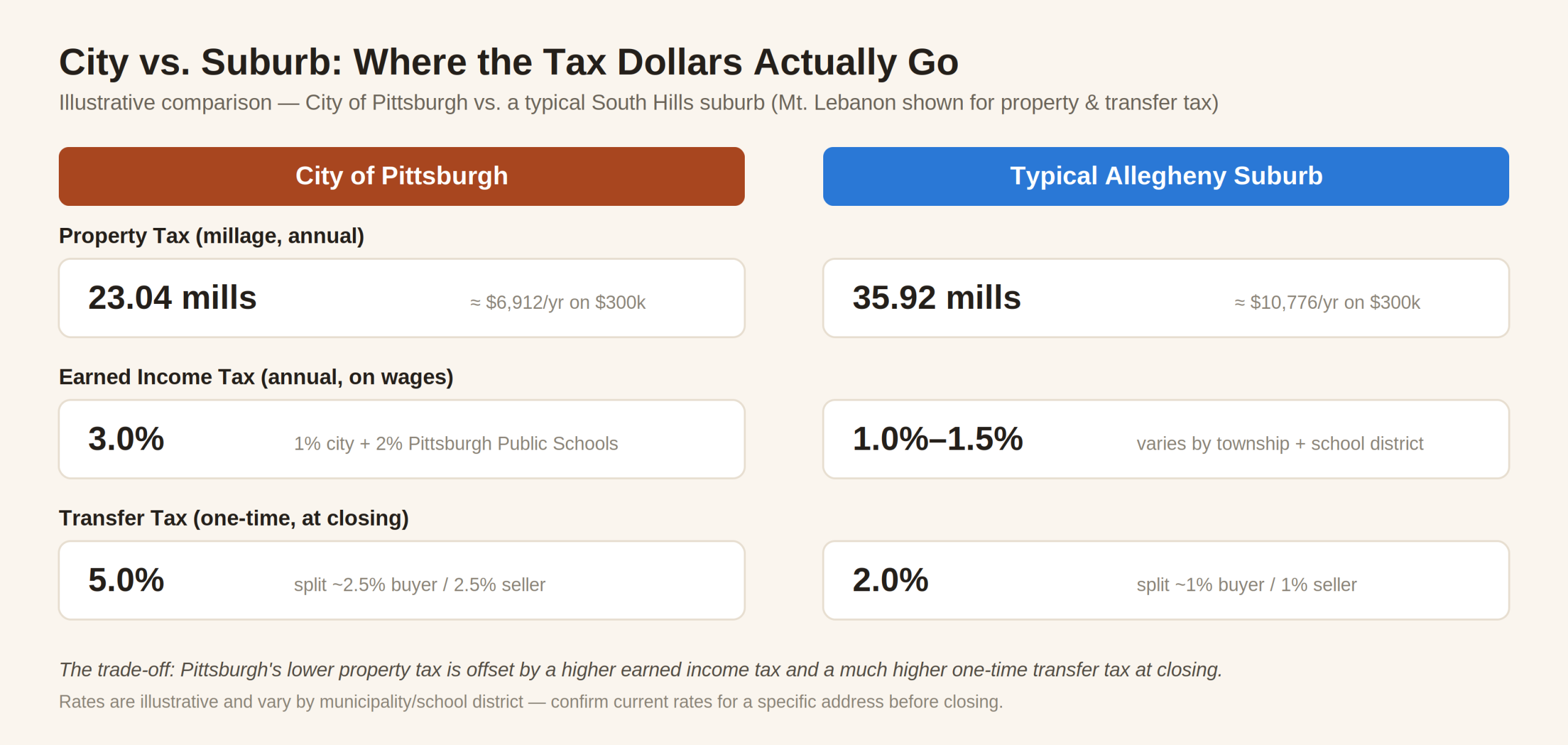
- City of Pittsburgh residents: 3.0% total — 1% to the city, 2% to Pittsburgh Public Schools.
- Most Allegheny County suburbs: roughly 1.0% to 1.5% total, split between the municipality and its school district. A North Hills example: Pine-Richland and Marshall Township residents pay about 1.0% combined.
On a household earning $120,000 a year in combined wages, that difference between 3.0% and 1.0% works out to about $2,400 a year. That’s real money, and it’s an ongoing cost — not a one-time closing line item.
There’s also a smaller, flat tax called the Local Services Tax (LST), typically capped around $52 a year, charged by the municipality where you work regardless of where you live. It’s not going to change your decision, but it’s worth knowing it exists so a small payroll deduction doesn’t catch you off guard.
The tax people really forget to compare: Transfer Tax
Pennsylvania charges a real estate transfer tax every time a property changes hands. It’s a percentage of the sale price, and by long-standing Pennsylvania custom, it’s typically split evenly between buyer and seller — though it’s technically negotiable in the agreement of sale.
Here’s where Pittsburgh stands out: it has the highest total transfer tax rate of any municipality in Pennsylvania, and it’s not particularly close.
- City of Pittsburgh: 5.0% total — 1% state, 2% city, 2% Pittsburgh school district. Split by custom: 2.5% buyer, 2.5% seller.
- Most Allegheny County suburbs (Mt. Lebanon, Bethel Park, Upper St. Clair, Green Tree, and many others): 2.0% total — 1% state, 1% local. Split by custom: 1% buyer, 1% seller.
On a $300,000 home, that’s the difference between $15,000 in combined transfer tax in the city and $6,000 in a typical suburb — a $9,000 gap, split between both parties at the closing table. Unlike property tax or EIT, this hits once, at closing, which is exactly why it’s so easy to underestimate when you’re focused on the monthly payment instead of the closing costs.
So which actually costs more — city or suburb?
Here’s an honest, side-by-side look at how it plays out for a hypothetical household earning $120,000 combined, buying a $300,000 home:
City of Pittsburgh
- Earned income tax: about $3,600/year
- Property tax: about $6,912/year (on a $300,000 assessed value at 23.04 mills)
- Combined annual recurring cost: about $10,512
- Transfer tax at closing: $15,000 total ($7,500 buyer’s share)
A typical South Hills suburb, like Mt. Lebanon
- Earned income tax: roughly $1,200–$1,800/year
- Property tax: about $10,776/year (on a $300,000 assessed value at 35.92 mills)
- Combined annual recurring cost: about $12,000–$12,600
- Transfer tax at closing: $6,000 total ($3,000 buyer’s share)
Look at that closely, and something surprising shows up: in this example, the city actually costs less per year to live in, once you combine property tax and earned income tax — even though its EIT rate is much higher. The lower millage rate does a lot of work. Where the city catches up is at the closing table, with a transfer tax bill more than double the suburban norm.
What this actually means for your decision
- If you’re planning to stay put for a long time, the city’s lower annual recurring cost can outweigh the higher upfront transfer tax within just a few years.
- If you expect to move again in the next few years, that higher transfer tax hits you again at your next sale, too — it’s not a one-and-done cost if you keep moving within city limits.
- Your actual number depends on your income and your home’s assessed value, not just the municipality’s name. A higher earner will feel the EIT gap more; a higher-value home will feel the property tax gap more.
None of this makes one choice universally right. It just means the full picture — property tax, earned income tax, and transfer tax together — tells a very different story than any one of them alone.
Frequently Asked Questions
Is Pittsburgh’s earned income tax higher than the suburbs?
Yes. City of Pittsburgh residents pay 3.0% total (1% city, 2% Pittsburgh Public Schools), while most Allegheny County suburbs land between 1.0% and 1.5% combined.
Does earned income tax depend on where I live or where I work?
Where you live. Your EIT rate is based on your municipality and school district of residence, regardless of where your job is located.
Why is Pittsburgh’s transfer tax so much higher than other municipalities?
Pittsburgh layers a 1% state tax with a 2% city tax and a 2% school district tax, for 5% total. Most Allegheny County suburbs only add a 1% local tax on top of the 1% state tax, for 2% total.
Who pays the Pennsylvania transfer tax, the buyer or the seller?
By long-standing custom, it’s typically split evenly between buyer and seller, though the specific split is technically negotiable and should be confirmed in your agreement of sale.
Does a lower property tax mean it’s cheaper to live in Pittsburgh overall?
Not automatically — it depends on your income and your home’s price point. Lower property tax can be offset by a higher earned income tax and a significantly higher transfer tax, so it’s worth running your specific numbers rather than assuming.
Property tax, earned income tax, and transfer tax all move independently of each other, and comparing towns on just one of them can lead you to the wrong conclusion. Help me understand your income and your price range, and I can walk you through what city living versus suburban living would actually cost you, all in. Does that make sense? Let’s run your numbers.
Leave a Reply